

Table of Contents
Enjoy the process:
It’s not always easy to walk a dog. It can be downright frustrating if you don’t know how to connect with your furry friend properly. In this five-part course, we will teach you everything you need to know about leash communication and how to walk your dog effectively. Dog walking requires a lot of mindfulness and patience, but with these tips, you’ll be able to handle any situation!
Training a dog to stop pulling on a leash requires leash and leadership skills. Following these instructions, your dog will find you exciting, fun to follow, and learn to walk calmly on a leash.
A dog pulling on the leash and one walking calmly by your side are two completely different states of mind to be in. If you allow your dog to continue walking when it pulls sometimes, but other times expect it to heel or stop moving, this can be confusing for your dog.
A fun and stress-free dog walk require that we come up with some agreements. At the least, the dog needs to learn that pulling will keep us from moving to its desired location.
Training your dog to walk with you can be a lifelong rewarding journey and a powerful relationship-bonding experience. Both you and your dog will learn about each other and yourselves on a much deeper level.
Dog training is a science; what you do with it is the art. Enjoy the process, and take it one win at a time.
The importance of being a leader:

As the old saying goes, “a walk is only as good as the company you keep.” That’s why it’s essential to be in a position of leadership and guidance regarding dog walking. After all, your dog is counting on you to keep them safe and prevent them from getting into trouble in a confusing world. By staying aware of each other and your surroundings, you can help to ensure that your dog has an enjoyable experience.
In addition, by being in a leadership position, you can help set the tone for the walk and make sure that it is a positive experience for both you and your dog. So next time you head out for a walk with your four-legged friend, remember that they depend on you to lead the way.
Keep in Mind:
- To be a successful leader for your dog, you must exhibit awareness, compassion, kindness, and self-confidence in every situation while maintaining the proper presence and firmness.
- Being a considerate leader means providing your dog with a task/job. This will help to reduce stress for both of you.
- Most issues on walks stem from a lack of leadership and agreements.
- Letting your dog take leadership in a stressful, confusing, and the distracting world can lead to unwanted behaviors and states of mind.
- Dogs respond best to being led, as it provides guidance and direction. Showing your dog love through leadership can also help remove anxiety, fear, reactivity, or aggression.
- Remember the 3C’s, D’s, and E’s when leading your dog and honoring your dog’s level of understanding and obedience.
- When we’re out on walks, it’s essential to keep a connection or a specific state of mind (normally calmness and focus), especially if the dog is walking toward something they want.
Walking Mindset and Patience:
Anyone who has tried to teach a dog to walk politely on a leash knows it takes a lot of patience. Dogs are naturally curious creatures and often want to stop and sniff everything they pass. This can make walking them on a leash challenging, especially if they’re constantly pulling or trying to dart off in different directions.
However, it’s important to remember that dogs are individuals like people, and some may require more patience and training than others. The right mindset is critical when teaching your dog to walk on a leash.
The key to success is having the right mindset. Rather than seeing it as a battle of wills, view leash training as an opportunity to bond with your dog and teach them something new. Be patient, consistent, and positive, and you will ultimately be rewarded with a well-behaved furry friend.
Be prepared for some bumps in the road, but remember that even the most rambunctious pup can be trained with time and patience.
Keep in Mind:
- When teaching new things, take your time, and do it when you are both in the right mindset and patience. Remember that you’re training your dog to love walking with you. Make it fun.
- As simple as this is, it takes a lot of reps. Dogs are individuals, so find what works for your dog.
- Quality over Quantity. Remember that it is not about the distance you walk but rather the quality of the walk. Focus on the intentions with your leash communication instead of the distance of the walk.
- Walks can be the most enjoyable and essential part of a dog’s day. Concentrate on making the best of it, even if it means not going far or doing new things.
- Stay focused; becoming distracted, using sloppy techniques and extreme/quick methods can create many unwanted outcomes.
- Be aware of your surroundings at all times, and be aware of what May trigger your dog.
BEFORE WE GET STARTED:
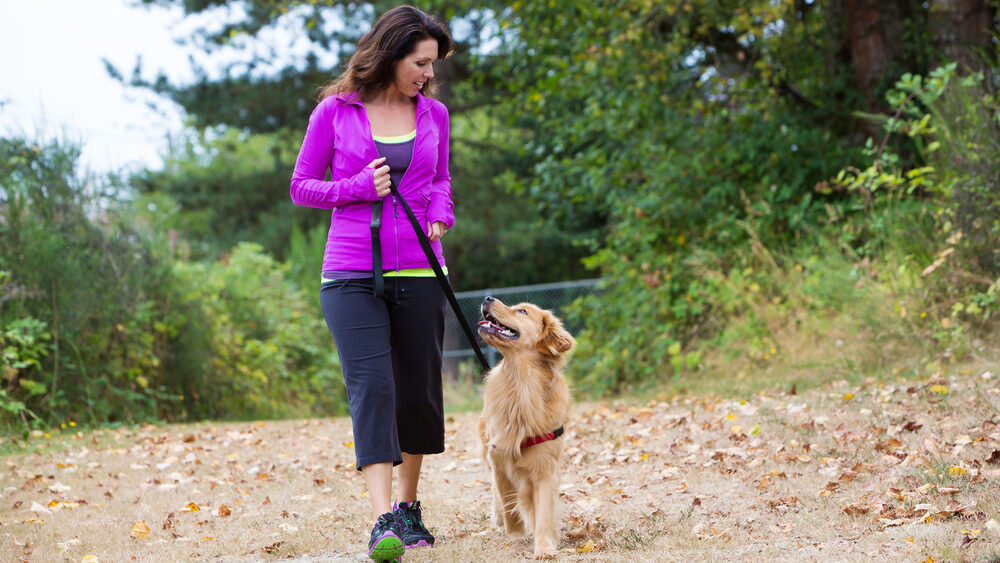
Engagement is always first: check-ins, eye-contact and/or a loose leash
Engagement is having your dog’s attention focused on you while working together. It is a two-way street – you are focused on your dog, and your dog is focused on you. When teaching your dog to walk politely on a leash, you must have engagement with your dog before and during walks, as well as when dealing with difficult situations.
Engagement from your dog means that they are listening to you and trying to understand what you want from them. To have engagement from your dog, you need to be able to capture its attention and keep it focused on you. This can be done by using treats, toys, or even making sure you can be a very interesting person.
Engagement is vital when teaching a dog to walk politely on a leash because it allows you to communicate with your dog and teach him what you expect from them. If your dog is not engaged with you, it will likely be distracted by things around them and will not be able to focus on learning how to walk politely.
Sometimes, walking your dog becomes problematic, such as when they see another dog or when there are lots of people or cars around. In these situations, it is even more important to have engagement from your dog so that you can keep his attention focused on you and prevent him from getting overwhelmed or stressed. Ideally, we would reach a state of mind where we could teach them how to handle those situations.
- For example : When starting Loose-Leash and Heel exercises with your dog, begin with Loose-Leash on your left side and Heel on your right. Heel exercises require more engagement, helping you assess what your dog can do with or without direction.
Overall, engagement is an essential part of dog training. It allows you to communicate with your dog and helps to prevent difficult situations from becoming overwhelming for both of you.
Keep In Mind:
Most walking issues are a lack of engagement: communication, connection, focus, and relationship. A dog needs to be engaged before asking them to do anything. If your dog is not engaged with you, it will likely be distracting and unable to focus on learning.
Put engagement on cue. First, teach your dog to focus on you, then put it on cue so you can ask for it when needed. Be aware of how much engagement you are asking for and how much your dog can give. Start with very low-level distractions and work up. Do not practice in high-level distraction areas until you have a strong foundation. Ensure that your dog is engaged with you before starting to walk.
It’s okay to build engagement without food first and then move towards food or toys for dialing in the Heel-work. This is something that can be taught through lifestyle changes and different methods.
Be aware of your dog’s body language. If something feels off, especially if they are trying to pull away, it may indicate they are uncomfortable or not ready to engage. In this situation, take leadership and find a safe place to recuperate.
Conclusion :
Teaching your dog to walk politely on a leash requires patience, consistency, and the right mindset. It is an opportunity to bond with your dog can be made enjoyable by keeping engagement as the primary focus. Remember to start small and build up to more challenging situations, always ensuring that your dog is engaged with you before starting a walk.

